
Minecraft Wilderness Bound: Dappled Forest, New Features & Update Guide
Minecraft Wilderness Bound is now live, bringing the new Dappled Forest biome, Poplar trees, Abandoned Camps, Explorer Maps, Straw Beds, Cushions, and new Wool and Concrete building blocks. Here’s what the update adds and how its new features work.
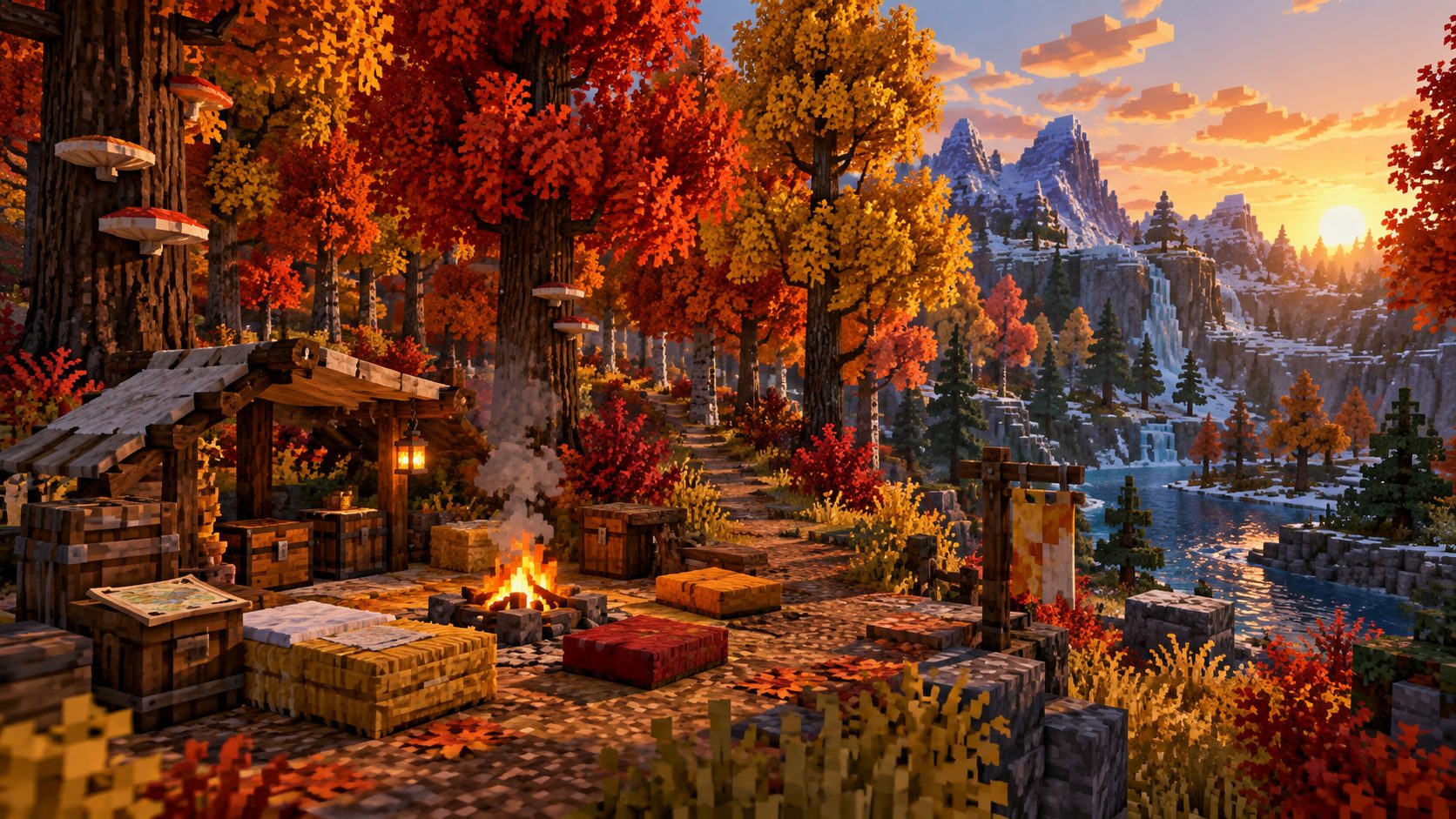
Minecraft Wilderness Bound Is Now Live
Minecraft Wilderness Bound is now available in Minecraft Java Edition 26.3, released on September 15, 2026. The update focuses heavily on exploration, camping, new building options, and a new forest environment called the Dappled Forest.
The biggest additions include the Dappled Forest biome, colorful Poplar trees, Shelf Mushrooms, Abandoned Camps, new Explorer Maps, Straw Beds, Cushions, Wool Stairs and Slabs, and Concrete Stairs and Slabs.
Instead of being just another biome update, Wilderness Bound gives players several reasons to explore: new structures contain loot and maps, the new biome introduces new natural resources, and some of the additions are useful for survival and building.
What's New in Minecraft Wilderness Bound?
The main Wilderness Bound additions include:
- Dappled Forest biome
- Poplar Trees and fallen Poplar Trees
- Red, Orange and Yellow Poplar Leaves
- Poplar wood set
- Shelf Mushrooms
- Red Shrubs
- Abandoned Camp structures
- New Explorer Maps
- Cushions in 16 colors
- Straw Beds
- Wool Stairs and Wool Slabs
- Concrete Stairs and Concrete Slabs
Minecraft Java Edition 26.3 also includes other changes and improvements, including Realms improvements, performance changes, and updates to Explorer Maps.
The headline gameplay additions, however, are the new biome, camps, and exploration system built around them.
Dappled Forest: The New Minecraft Biome
The Dappled Forest is the centerpiece of Wilderness Bound.
It is a new forest biome that generates near cold biomes. The biome contains Poplar Trees, fallen Poplar Trees, Shelf Mushrooms, Red Shrubs, and a Dappled Forest variant of the new Abandoned Camp structure.
Players can also encounter several passive and neutral mobs there, including sheep, chickens, cows, pigs, rabbits, and foxes.
The biome is designed around a more varied forest environment rather than simply adding another type of tree. Its Poplar trees introduce multiple leaf colors, while the new camps provide a reason to explore beyond simply collecting wood.
How to Find the Dappled Forest
Mojang's official Java 26.3 documentation says that Dappled Forest biomes can be found near cold biomes.
That gives players a useful starting point when exploring a new world: pay attention to areas around cold-biome regions and look for the distinctive Poplar trees and their colored leaves.
There is no need to treat the Dappled Forest like a structure with a single fixed location. It is a biome, so exploration and world generation determine where it appears in a particular world.
Once you find one, it is worth looking around the surrounding area for an Abandoned Camp.
Poplar Trees Add Three Leaf Colors
Poplar Trees are one of the most recognizable additions in Wilderness Bound.
They come in three leaf-color variants:
- Red Poplar Leaves
- Orange Poplar Leaves
- Yellow Poplar Leaves
Each variant also has matching falling-leaf particles, giving the trees a different appearance from many of Minecraft's existing forests.
Poplar Leaves can drop Poplar Saplings. When planted, a Poplar Sapling can randomly grow into any of the three variants.
Poplar Saplings can also appear in Wandering Trader trades.
The trees use Poplar Logs, which can be crafted into a new Poplar wood set. This makes the Dappled Forest useful not only for exploration but also for players looking for new building materials.
Shelf Mushrooms Explained
Shelf Mushrooms are another new feature found around Poplar Trees and fallen Poplar Trees.
They come in small and large sizes. A small Shelf Mushroom can be grown into a large one using Bone Meal.
Breaking a large Shelf Mushroom drops two Shelf Mushroom items.
They can also be used like other mushrooms when making stews, and Wandering Traders can offer them in trades.
There is also a small gameplay detail that makes Shelf Mushrooms different from ordinary decorative blocks: they have a slight bounce when a living entity steps on them.
Red Shrubs Add Another New Plant
Red Shrubs are decorative plant blocks that generate in small patches throughout the Dappled Forest.
They can be placed as part of a build and can also be used in a Composter.
Using Bone Meal on a Red Shrub can grow another Red Shrub in a random adjacent space when there is room.
They are a relatively small addition, but they give players another decorative resource to collect from the new biome.
Abandoned Camps Are the Other Major Addition
Wilderness Bound also introduces Abandoned Camps.
These structures can generate across a large selection of biomes, including:
- Meadow
- Cherry Grove
- Forest
- Birch Forest
- Old Growth Birch Forest
- Flower Forest
- Windswept Forest
- Dappled Forest
- Taiga
- Snowy Taiga
- Old Growth Spruce Taiga
- Old Growth Pine Taiga
- Sparse Jungle
- Bamboo Jungle
- Swamp
- Savanna
- Wooded Badlands
- Pale Garden
Each biome has its own version of the structure, with the design adapted to its surroundings.
Abandoned Camps can also contain Chests and Barrels with loot.
That makes them more than scenery. They are another exploration target that can reward players who investigate the surrounding wilderness.
Abandoned Camp Explorer Maps
One of the more useful additions to the camps is the new Explorer Map system.
Abandoned Camps can contain maps that point players toward other Abandoned Camps in several different biomes.
The supported camp destinations include:
- Bamboo Jungle
- Cherry Grove
- Birch Forest
- Dappled Forest
- Flower Forest
- Pale Garden
- Swamp
- Windswept Forest
There are also maps leading to other structures, including:
- Ancient City
- Trial Chambers
- Mineshaft
- Desert Pyramid
- Jungle Pyramid
- Warm Ocean Ruins
- Woodland Mansion
This creates a natural exploration loop: find a camp, search its loot, obtain a map, and use that map to continue exploring.
For players who enjoy exploration more than simply settling in one location, this is one of the most significant practical additions in Wilderness Bound.
Straw Beds: How They Work
Straw Beds are designed for players who need a temporary place to sleep while exploring.
They have one major difference from ordinary beds:
A Straw Bed does not set your spawn point.
A Straw Bed can be used to sleep through the night, but it is consumed after being used once.
They also cannot be used in the Nether or the End. Attempting to sleep on one in either dimension destroys it.
The crafting recipe is simple:
3 Hay Bales → 4 Straw Beds
This makes Straw Beds particularly suited to temporary expeditions. Instead of carrying or placing a permanent bed and changing your spawn point, you can use Straw Beds as disposable sleeping equipment while traveling.
Minecraft also adds a statistic tracking how many times you have slept in a Straw Bed.
Cushions Add 16 Seating Options
Cushions are another smaller but distinctive addition in Wilderness Bound.
They are placeable items that players can sit on, and they come in 16 colored variants.
A Cushion is crafted using:
3 Wool Slabs of the same color
Cushions can be placed on flat surfaces. They do not have normal collision and can overlap with other objects in certain situations, although they cannot overlap with another Cushion.
They are mainly a building and decoration feature, giving players another way to make camps, bases, houses, and other interiors feel more lived-in.
New Wool and Concrete Building Blocks
Wilderness Bound also expands Minecraft's building options.
Every colored Wool block now has matching:
- Wool Stairs
- Wool Slabs
These retain Wool's ability to dampen vibrations.
Every colored Concrete block also gets:
- Concrete Stairs
- Concrete Slabs
Concrete Stairs and Slabs can additionally be crafted using a Stonecutter.
For builders, these additions are useful because they allow more detailed structures without relying on workarounds using other block types.
Explorer Maps Have Also Changed
Wilderness Bound includes a broader change to how Explorer Maps work in Java Edition.
Explorer Maps are now their own item types rather than simply renamed Filled Maps, and each type has its own icon.
This includes maps for structures such as:
- Ocean Monuments
- Woodland Mansions
- Trial Chambers
- Jungle Pyramids
- Mineshafts
- Ancient Cities
- Abandoned Camps
- Warm Ocean Ruins
Existing Explorer Maps in older worlds are converted to their corresponding new item type when the world is loaded.
There are also changes to map zooming. Explorer Maps and Buried Treasure Maps can no longer be zoomed out through the Crafting Table or Cartography Table unless the map belongs to the appropriate extendable-map category.
What Should You Collect First?
If you are starting an expedition into Wilderness Bound content, there are several useful things to look for.
1. Poplar Saplings
The three Poplar variants give you access to the new tree colors and Poplar wood.
Because a planted Poplar Sapling can randomly grow into one of the three variants, collecting several saplings can help you establish the different looks at your own base.
2. Shelf Mushrooms
Shelf Mushrooms are useful for stews and also provide a distinctive decorative element.
Collecting them while exploring the Dappled Forest means you do not necessarily need to return later just to obtain them.
3. Hay Bales
If you expect to travel for a while, Hay Bales are useful because they can be converted into Straw Beds.
Three Hay Bales produce four Straw Beds, giving you disposable sleeping options for an expedition.
4. Abandoned Camp Maps
The camps are worth investigating because their Explorer Maps can point toward other camps and several existing structures.
Finding one can therefore lead to a longer exploration trip rather than being a single destination.
5. New Building Materials
Poplar wood, Wool Stairs and Slabs, and Concrete Stairs and Slabs give builders more options once they return to their base.
Is Wilderness Bound Mainly an Exploration Update?
Exploration is clearly the main theme of Wilderness Bound, but the update is not limited to exploration.
Players interested in different parts of Minecraft get something different from the update.
Explorers get Dappled Forests, Abandoned Camps, loot, and new maps.
Survival players get temporary Straw Beds and new resources to collect while traveling.
Builders get Poplar wood, colorful leaves, Cushions, Wool Stairs and Slabs, and Concrete Stairs and Slabs.
Players who enjoy atmospheric builds can use the new camps, cushions, colored Poplar leaves, mushrooms, and shrubs to create more detailed outdoor areas.
The update therefore works as both a world-exploration expansion and a building-content update.
Minecraft Wilderness Bound: Java and Bedrock
Wilderness Bound is available across Minecraft's Java and Bedrock editions, with the Java release documented as version 26.3 and the corresponding Bedrock release documented separately.
The core Wilderness Bound theme is shared across the editions: the Dappled Forest, Poplar trees, Abandoned Camps, new exploration features, Straw Beds, Cushions, and additional building blocks are the major additions.
Players should check the release notes for their specific edition when relying on version-specific technical details.
Final Thoughts
Minecraft Wilderness Bound adds more than another biome to explore.
The Dappled Forest provides a new environment with three-color Poplar trees, Shelf Mushrooms, Red Shrubs, and its own Abandoned Camp variant. Those camps then connect exploration to a new set of Explorer Maps, creating a reason to keep traveling after finding the first camp.
For survival players, Straw Beds provide a temporary sleeping option without changing the player's spawn point. Builders get new Poplar materials, Cushions, Wool Stairs and Slabs, and Concrete Stairs and Slabs.
The result is an update built around a simple idea: explore farther, find a camp, follow the maps, collect new materials, and bring what you discover back to your own builds.
Sources
- Minecraft Wilderness Bound — Drop 3 2026 — Minecraft
- Minecraft Java Edition 26.3 — Minecraft
- Bedrock Edition 26.50 Changelog — Wilderness Bound — Minecraft Feedback