What Is an AI Agent? How AI Agents Work and What They Can Do
AI agents can pursue a goal, use tools and act on the results. Learn how they work, how they differ from chatbots and automation, and the risks to understand.
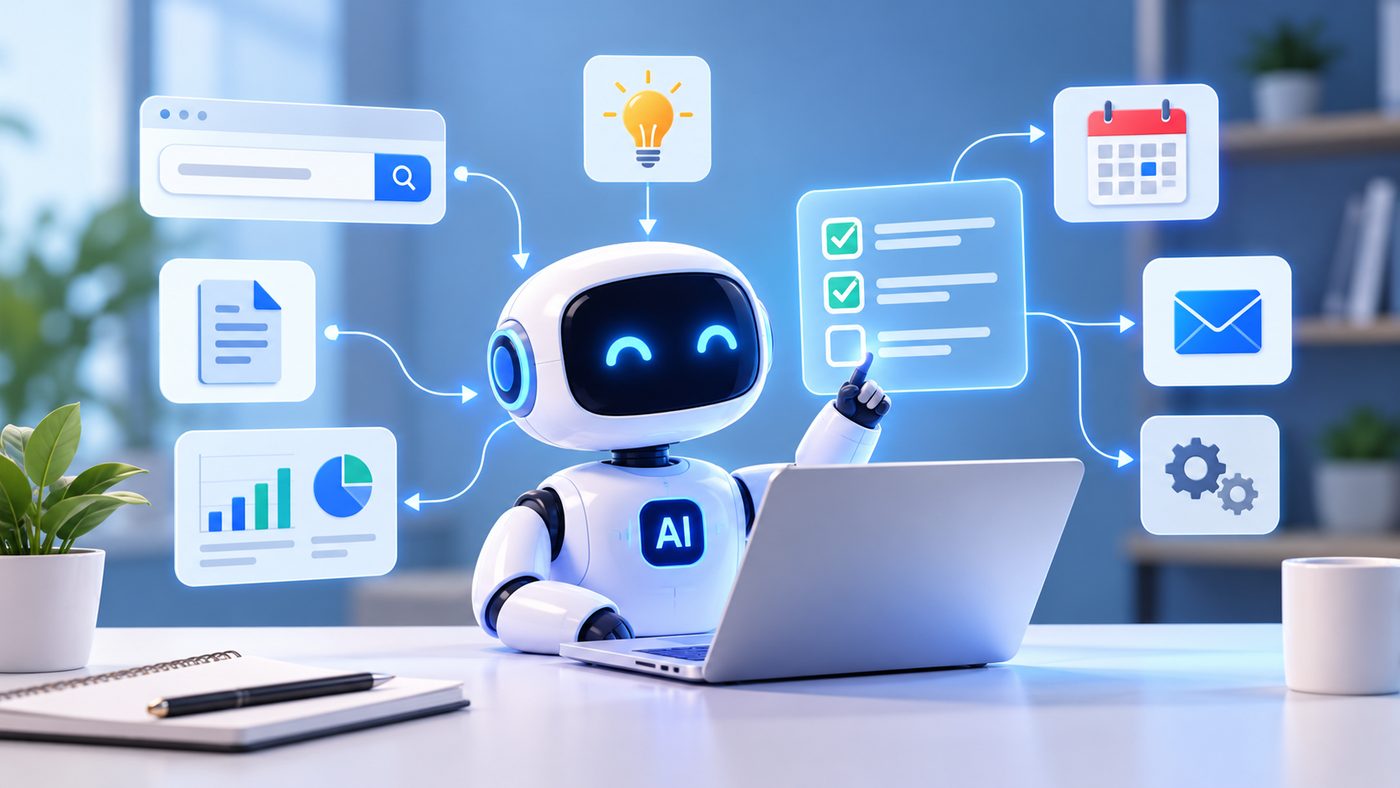
AI agents are becoming a common way to describe AI systems that can do more than simply generate a response. Instead of only answering a question, an agent can be given a goal, decide what steps are needed, use available tools, evaluate the results, and continue until the task reaches an appropriate stopping point.
The term can cover different kinds of systems, but modern AI agents often use large language models to interpret instructions and make decisions during a multi-step task. Their level of autonomy varies: some require frequent human input, while others can complete defined tasks with limited supervision.
What Is an AI Agent?
An AI agent is a software system designed to pursue a goal by interpreting information, deciding what action to take, and carrying out permitted actions to make progress toward that goal.
A useful way to think about a modern AI agent is:
Goal → decide → act → observe the result → decide what to do next
For example, imagine an agent is asked to investigate why an online order has not arrived. It could retrieve the order information, check the available shipping data, look for the latest status, interpret what happened, and then explain the result to the user.
That is different from a system that simply generates an answer from the text in a single prompt.
Not every application that uses AI is an agent. A simple chatbot or single-turn AI response does not automatically become an agent just because it uses a powerful language model. A key characteristic is that the AI has some control over the process used to accomplish the task.
How Do AI Agents Work?
Although implementations vary, a modern AI agent can work through several steps.
- Receive a goal: The agent receives a request or objective from a person or another system.
- Understand the task and available context: It interprets the request and considers the information it has been given or can retrieve.
- Decide on the next action: The AI model determines what should happen next based on the goal, instructions, available information, and available tools.
- Use a tool when necessary: An agent may have access to tools such as search, databases, APIs, files, calculators, or business applications. Tools allow the system to retrieve information or perform actions outside the model itself.
- Observe the result: The result of a tool call or other action becomes new information that the agent can use.
- Continue or finish: The agent evaluates whether the task is complete. If another step is necessary, it can continue; otherwise, it returns a result or hands control back to a person.
This repeated process is one of the main differences between a simple prompt-and-response application and an agent that can manage a multi-step workflow.
What Are the Main Parts of an AI Agent?
Modern agent systems commonly combine several components.
- AI model: Many current agents use a large language model or another foundation model to interpret instructions, reason about available information, and determine actions.
- Instructions and goals: These define what the agent is supposed to accomplish and the boundaries within which it should operate.
- Tools: Tools connect the agent to external information and systems. They might allow it to search the web, retrieve database records, read files, call APIs, or update another application.
- Memory or state: Some agents maintain relevant information between steps or interactions, which can help preserve context as a task progresses.
- Guardrails and permissions: These restrict what the agent can access or do. They can also determine when a human needs to approve an action.
Not every agent has exactly the same architecture. A simple agent may use only a model, instructions, and a few tools, while more complex systems can include multiple agents, external data sources, memory systems, and additional controls.
AI Agents vs. Chatbots
AI agents and chatbots can overlap, especially as modern chatbots gain access to tools. The important difference is not simply whether the system can have a conversation.
A basic chatbot typically responds to a user's input. An agent can have greater control over the process used to achieve a goal, including deciding which tools to use and whether another step is necessary.
For example, a chatbot might answer a question about an order. An agent could potentially retrieve the order, check its shipping status, contact an approved service, and report the result, provided those capabilities and permissions have been given to it.
So the more useful distinction is response generation versus goal-oriented task execution, rather than "chatbot talks, agent acts."
AI Agents vs. Traditional Automation
Traditional automation usually follows a predefined workflow.
If X happens → perform Y.
This works extremely well when the process is predictable.
An agent can be more flexible because the AI can determine which steps to take based on the current situation.
Goal → determine the next appropriate step → act → evaluate the result → continue.
That flexibility does not make agents better for every task. If a process is simple, predictable, and well defined, conventional automation may be easier to test, control, and maintain. Agents become more interesting when a task involves changing information, multiple possible paths, or decisions that are difficult to encode entirely as fixed rules.
Examples of AI Agents
AI agents can be used in many different types of workflows.
- Research agents can gather information from permitted sources, organize findings, and produce a report.
- Coding agents can inspect a codebase, make changes, run tests, examine the results, and continue working through a development task.
- Customer-support agents can retrieve account or order information, determine an appropriate response, and perform approved support actions.
- Business workflow agents can work with information from several systems and carry out defined operations based on the situation.
More complex systems can also use multiple specialized agents. One agent might coordinate a task while other agents handle research, analysis, coding, or another specialized part of the workflow.
What Are AI Agents Good At?
AI agents are particularly useful when a task:
- involves several steps
- requires information from different sources
- involves external tools or systems
- has a reasonably clear goal
- requires some flexibility in deciding what to do next
- can be evaluated for whether the goal was achieved
They are less compelling when a task is already simple and predictable enough for a conventional script or fixed workflow.
In practice, the best solution is often not the most autonomous one. The appropriate level of automation depends on the task, the consequences of mistakes, and the amount of control required.
Are AI Agents Safe?
AI agents can introduce additional risks because they may be able to interact with external systems and take actions.
Potential problems include incorrect decisions, inaccurate AI-generated information, prompt injection, unintended tool use, excessive permissions, data exposure, and actions that are difficult to reverse.
The more access an agent has, the more important its safeguards become. An agent that can only retrieve public information presents a different risk from one that can send messages, modify records, access sensitive data, or make financial changes.
Safer agent systems generally limit permissions, provide only the tools that are necessary, validate important operations, monitor activity, and require human approval for sensitive actions when appropriate.
The goal is not to eliminate human involvement in every situation. Instead, the system should have an appropriate level of autonomy for the task it is performing.
What Is Agentic AI?
Agentic AI is a broader term used to describe AI systems designed to pursue goals and take actions with some degree of autonomy.
The terminology is not completely standardized across the industry. In practice, the term is often used for systems that can reason about a goal, plan or select actions, interact with tools, and adapt their next steps based on what happens.
AI agents are one important way of building agentic AI systems, but the terms are not always used identically by different organizations.
Frequently Asked Questions
What is an AI agent?
An AI agent is a software system designed to pursue a goal by interpreting information, deciding what actions to take, and using available tools or systems to complete a task.
How do AI agents work?
A modern AI agent can receive a goal, determine the next step, use available tools, observe the result, and continue until the task is completed or requires human intervention.
What is the difference between an AI agent and a chatbot?
A chatbot primarily provides conversational responses, while an agent can have greater control over a multi-step process and take permitted actions toward a goal. Modern chatbots can also use tools, so the distinction is about task execution and control rather than conversation alone.
What are examples of AI agents?
Examples include research agents, coding agents, customer-support agents, and systems that automate complex business workflows.
Do AI agents work without humans?
Some agents can perform defined tasks with limited human intervention, but their autonomy varies. Sensitive or high-impact actions may require human approval.
Are AI agents the same as automation?
No. Traditional automation generally follows predefined rules or workflows, while an agent can dynamically determine actions within the instructions, tools, and permissions it has been given.
The Bottom Line
AI agents are best understood as a way of moving from simply generating an answer toward carrying out parts of a task. Their usefulness depends on the quality of the AI model, tools, information, permissions, and safeguards behind them. For predictable jobs, conventional automation may still be the better choice. For complex tasks requiring flexible decisions across multiple steps, an agent can provide a more capable approach.
Sources
- What are AI agents? Definition, examples, and types — Google Cloud
- A practical guide to building agents — OpenAI
- What are AI Agents? Agents in Artificial Intelligence Explained — Amazon Web Services
- Building Effective Agents — Anthropic
- LLM06:2025 Excessive Agency — OWASP